What Should You Do If Someone Falls Overboard From a Boat?
What should you do if someone falls overboard from a boat?
This is an emergency I hope I never experience, but every boat operator should be prepared for it. Recovering a person from the water can be much harder than people expect, especially when there is wind, current, rough water, darkness, cold water, or limited visibility.
The most important things are to remain calm, keep the person in sight, immediately provide flotation, control the boat safely, protect the person from the propeller, and call for help when needed.
This article provides general boating-safety information. Every boat handles differently, and the correct maneuver can change with current, wind, visibility, boat design, and the condition of the person in the water. Hands-on boating-safety and first-aid training are strongly recommended.
1. Shout “Person Overboard”
As soon as someone falls from the boat, loudly shout:
“Person overboard!”
This alerts everyone aboard and immediately changes the crew’s focus from fishing or boating to the rescue.
If other capable passengers are aboard, assign one person to point continuously at the person in the water. That person should not look away, even briefly.
Wind, waves, current, glare, darkness, and boat movement can make someone in the water surprisingly difficult to see. Bright clothing, reflective material, a life jacket, and a light can make a major difference.
2. Throw Flotation Immediately
Immediately throw a throwable flotation device, life ring, flotation cushion, or another buoyant object toward the person.
Throw the device close enough for the person to reach without striking them with it. Even if the person is already wearing a life jacket, additional flotation can help mark their location and give them something visible to hold.
If the person is not wearing a life jacket, getting flotation to them may be the most important first action.
Do not wait until the boat has turned around before throwing flotation. The sooner the person has something buoyant, the better.
3. Keep the Person in Sight
Never take your eyes off the person in the water.
If more than one person remains aboard, one passenger should be assigned only to pointing and watching. That person should give the boat operator continuous directions such as:
- “Straight ahead”
- “Off the port side”
- “Off the starboard side”
- “Behind us”
At night, shine a light toward the person without blinding the boat operator. A light attached to the person’s life jacket can make them much easier to locate.
If you lose sight of the person, immediately note the last known position and call for emergency help.
4. Mark the Position on Your GPS
If your GPS or chartplotter has a man-overboard button, press it immediately.
The MOB function marks the location where the button was pressed and can help you return to the area if the person disappears from sight.
Remember that wind and current may move both the person and the boat away from the original position. The marked location is an important reference point, but it does not replace keeping the person visually located.
The Coast Guard has specifically advised boaters in a person-overboard emergency to remain calm, mark the position on the GPS, and throw flotation toward the person.
5. Slow Down and Control the Boat
Immediately reduce speed and begin a safe return maneuver.
Do not make a sudden turn that could throw another passenger overboard. Make sure loose passengers are seated or holding a secure handhold before maneuvering.
The exact return maneuver depends on your boat, current, wind, waves, and surrounding traffic. Approach slowly and under control.
Whenever practical, approach from downwind or down-current so the boat drifts toward the person instead of being blown or pushed away from them.
Avoid backing toward the person. A moving propeller is one of the greatest dangers during a recovery.
6. Protect the Person From the Propeller
As you get close, keep the person away from the stern, outboard motor, propeller, and any moving machinery.
Shift the motor into neutral before the person is close enough to contact the boat. Shut the engine off before the person is brought into the reboarding area whenever it is safe to do so.
Do not assume that neutral completely eliminates every hazard. The person should be kept clear of the propeller and lower unit throughout the recovery.
Bring the person alongside the safest and lowest practical reboarding point on your boat. Depending on the boat, this may be along the side, at a boarding door, swim platform, or another designated recovery area.
Do not automatically bring the person to the stern while the motor is operating.
7. Call for Emergency Help When Needed
A person-overboard emergency can become life-threatening quickly. Call for help if:
- The person cannot be recovered immediately
- You lose sight of the person
- The person is injured or unconscious
- The water is cold
- Conditions are rough or visibility is poor
- The boat is disabled
- You need medical assistance
If your VHF radio has Digital Selective Calling and is properly connected to GPS and programmed with an MMSI number, activate the distress function according to the radio manufacturer’s instructions.
Then use VHF Channel 16 and clearly say:
“MAYDAY, MAYDAY, MAYDAY.”
Provide:
- Your boat name or registration number
- Your location or GPS coordinates
- That you have a person overboard
- The number of people aboard and in the water
- A description of the person and what they are wearing
- Whether the person is wearing a life jacket
- The person’s last known location
- Any injuries or medical concerns
- A description of your boat
Stay near the radio and listen for instructions.
Review the official United States Coast Guard VHF distress-call procedure.
8. Bring the Person Back Aboard
Getting a cold, exhausted, injured, or unconscious person back into a boat can be the most difficult part of the rescue.
Use the safest available reboarding method, such as:
- A boarding ladder
- A swim platform with the engine shut off
- A Lifesling or similar recovery device
- A secured rope loop
- A low boarding door
- A strong line or handle the person can hold
- Assistance from multiple capable passengers
A person in cold water may lose grip strength and may be unable to climb even a short ladder. Be prepared to support or lift them.
Whenever possible, bring the person aboard horizontally or as gently as practical, especially after prolonged cold-water exposure.
Do not pull someone aboard by only one arm, their neck, or loose clothing unless there is no safer alternative during an immediate life-threatening emergency.
Do Not Jump Into the Water Unless Absolutely Necessary
Entering the water can turn one victim into two.
Use flotation, lines, a ladder, a recovery sling, or another method from inside the boat whenever possible.
If entering the water becomes the only possible way to prevent an immediate loss of life, the rescuer should wear a properly fitted life jacket and remain secured to the boat with an appropriate line when possible.
This should be a last resort, not the normal recovery method.
What If the Person Is Unconscious?
An unconscious person may be unable to hold flotation, grab a line, or climb a ladder.
Call for emergency assistance immediately. Keep the person’s face above the water and use the safest available recovery equipment.
Once the person is aboard:
- Check for normal breathing
- Call 911 or continue communicating with the Coast Guard
- Begin CPR if they are not breathing normally and you are trained
- Use an AED if one is available and follow its instructions
- Continue care until professional help arrives
Even if the person appears to recover, medical evaluation may be necessary after drowning, near-drowning, injury, or significant cold-water exposure.
Cold-Water Immersion and Hypothermia
The Columbia River, Pacific Ocean, bays, and many Oregon waterways remain cold even when the air feels warm.
Sudden cold-water immersion can cause involuntary gasping, rapid breathing, panic, confusion, and loss of muscle control. A person may quickly lose the ability to swim, hold a line, or climb back aboard.
After recovering someone from cold water:
- Move them to a protected area
- Handle them gently
- Remove wet clothing when practical
- Dry the person
- Replace wet clothing with dry layers
- Wrap them in blankets
- Warm the chest and core gradually
- Monitor breathing and responsiveness
- Seek emergency medical help when needed
Do not try to warm a severely cold person rapidly by placing them in very hot water. Do not give alcohol.
The person’s core temperature may continue dropping even after they are removed from the water.
Learn more through the official National Weather Service cold-water safety guide.
Life Jackets Save Valuable Time
The best person-overboard rescue is one in which the person is already wearing a properly fitted life jacket.
A life jacket helps keep the person afloat during the first moments of cold shock, when breathing and clear thinking may be difficult. It also gives the boat operator more time to return safely.
Every person aboard should have a properly sized, United States Coast Guard-approved life jacket.
I personally like inflatable life jackets for many fishing situations because they are comfortable and less restrictive. However, an inflatable life jacket only works properly when it is worn, armed, maintained, and used according to the manufacturer’s instructions.
Regularly inspect an inflatable life jacket for:
- A properly installed CO₂ cylinder or cartridge
- A green or ready status indicator when applicable
- Damage, corrosion, punctures, or excessive wear
- A working oral inflation tube
- Correctly secured closures and straps
- The manufacturer’s recommended service dates
Review the official United States Coast Guard life-jacket guidance.
Use the Engine Cut-Off Switch
If the boat operator falls overboard, an unmanned powerboat can continue moving and may begin circling. This creates a serious propeller and collision hazard.
An engine cut-off switch is designed to stop the propulsion engine when the operator is displaced from the helm.
Depending on the boat, the engine cut-off link may be a physical lanyard attached to the operator or an approved wireless device.
Use and maintain the engine cut-off system as required for your boat. Learn more from the United States Coast Guard engine cut-off switch guide.
Practice a Person-Overboard Drill
The middle of an emergency is not the best time to learn how your boat turns, where the flotation devices are stored, or how someone will climb aboard.
Practice with a floating cushion, buoy, or another harmless object—not a person.
A practice drill can help you learn:
- How quickly your boat stops
- How large its turning circle is
- How wind and current move the boat
- How to use the MOB button
- Where to safely approach the person
- How to shift into neutral and shut off the engine
- How your reboarding equipment works
- How passengers should communicate
- Where the VHF radio and emergency equipment are located
Everyone aboard should know where the life jackets, throwable flotation device, VHF radio, first-aid kit, flares, and fire extinguishers are stored.
Read my updated guide explaining what type of flares you should carry on your boat.
What I Carry on My Fishing Guide Boat
As a professional fishing guide, I operate on large rivers, bays, estuaries, and coastal water where wind, current, tides, fog, waves, and cold water can make emergencies more difficult.
My guide boat carries important communication, navigation, and safety equipment, including:
- United States Coast Guard-approved life jackets
- Throwable flotation equipment
- A VHF marine radio
- GPS and chart-plotting equipment
- Radar
- Visual distress signals and marine flares
- Navigation lights
- Fire extinguishers
- A first-aid kit
- Other required emergency equipment
I also pay close attention to wind, weather, water temperature, tides, river flow, visibility, and coastal bar conditions before leaving the dock.
Learn more about my equipment on my Columbia River fishing guide boat page.
Person-Overboard Safety Near Astoria and Buoy 10
Lower Columbia River conditions near Astoria and Buoy 10 can include strong tides, changing currents, wind, fog, boat traffic, cold water, and rough conditions near the Columbia River bar.
These conditions make wearing life jackets, keeping safety equipment accessible, monitoring the weather, and maintaining good communication especially important.
Learn more about fishing these waters on my Astoria Oregon fishing guide, Buoy 10 salmon fishing guide, and Columbia River fishing guide pages.
Final Person-Overboard Checklist
If someone falls overboard:
- Shout “Person overboard!”
- Throw flotation immediately
- Assign someone to keep pointing at the person
- Press the GPS man-overboard button
- Reduce speed and return under control
- Call for emergency help when needed
- Keep the person away from the propeller
- Shift into neutral and shut off the engine before recovery
- Use a ladder, line, sling, or another safe reboarding method
- Treat injuries and cold-water exposure
- Seek medical assistance when necessary
A person-overboard emergency can happen in seconds. Wearing life jackets, practicing the recovery procedure, maintaining communication equipment, and knowing how to bring someone aboard can save a life.
Everybody, please be safe on the water. Accidents can happen even to experienced boaters.
Call or text Marvin at 503-314-5087 or send a fishing-trip inquiry online.
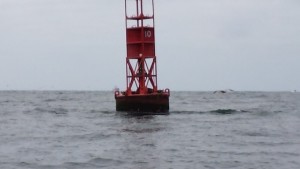
Fishing near Buoy 10 on the Columbia River bar.
Person-Overboard Frequently Asked Questions
What is the first thing you should do when someone falls overboard?
Shout “Person overboard,” throw flotation immediately, and assign someone to maintain constant visual contact with the person.
Should you turn the boat around immediately?
Reduce speed and return under control. Avoid sudden maneuvers that could throw another person overboard, and do not back the propeller toward the person in the water.
Should you bring a person overboard to the stern?
Not while the propeller creates a danger. Bring the person to the safest practical reboarding point and shift into neutral and shut off the engine before the person reaches the propeller or reboarding area.
What VHF channel should you use for a person-overboard emergency?
Use VHF Channel 16 for a distress call. Clearly state “Mayday” three times and provide your location, boat description, number of people, and details about the person in the water.
Should you jump into the water to rescue someone?
Entering the water should normally be a last resort because the rescuer can become a second victim. Use flotation, lines, a ladder, or another recovery system from the boat whenever possible.
Why should you press the MOB button?
The MOB button records the location where the person entered the water. This provides a reference point if the person disappears from sight, although wind and current may move the person away from the original position.
How should you warm someone after cold-water immersion?
Move the person to a protected area, remove wet clothing when practical, dry them, wrap them in blankets, and warm the body’s core gradually. Monitor breathing and seek emergency medical assistance when necessary.