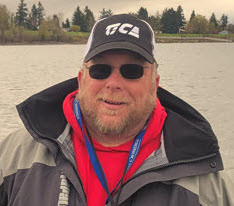
This is how Marvin’s Guide Service rigs up for walleye — not necessarily the best way, but it’s what’s worked best in Marvin’s boat over the years.
Walleye fishing on the Columbia River rewards the anglers who pay attention to the details. The river is big, the fish move, and the difference between a slow day and a great day usually comes down to rigging: the right setup fished the right way at the right depth. Here’s how I rig up in my boat, and why.
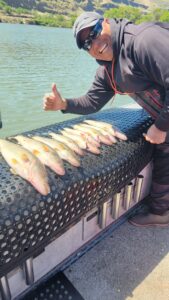
Happy client with Walleye caught with Marvin’s guide service on the Columbia River near Rufus.
Line-Counter Reels and Line
A line-counter reel is highly recommended. When you’re running multiple rods and you find the depth that’s producing, the line counter lets you put every rod right back on that number — no guessing.
I use 20-pound braid line. Some people might think that’s heavy, but when you’re pulling along the rocks and you hang up, most of the time you can get your bottom walker back. That braid has saved me more rigs than I can count.
I tie all of my worm harnesses and my jigs up with 15-pound fluorocarbon leader.
Worm Harnesses
I like pulling worm harnesses — and making sure I’m dragging the bottom. If you’re not ticking bottom, you’re not where the walleye live.
I tie my worm harnesses with smile blades and a couple of beads. Not too many beads. The color varies — you have to find the color that’s working from day to day. What they wanted yesterday might not be what they want today.
I run bottom walkers anywhere from seven feet to 35 feet of water, depending on the current. I’m generally running a three- to four-ounce bottom walker.
On trolling speed: I like to keep my lines at about a 45-degree angle, but I go as slow as possible — while still hitting the bottom. That slow drag along the rocks is what gets bit.
Trolling Plugs to Locate Fish
Sometimes we’ll troll plugs, because you can cover a lot of water, and you can cover it fast. I generally like trolling the plugs downriver.
One problem with trolling plugs: we do catch a lot of smallmouth bass. But you can cover a lot of water fast to find the walleye — and once you find them, that’s when I’ll switch to jigs or bottom walkers.
Jigging
If I find a pile of walleye and the wind is allowing — which means the boat’s not blowing over — I like to switch to jigs. I can stay right on top of those fish anywhere from 10 to 40 feet of water and just jig on them.
When jigging, I jig very slow. When it hits the bottom, I only pull it a couple of inches off the bottom — not a high swing. Very slow. A lot of guys work a jig way too hard. On the Columbia, slow and low catches walleye.
GPS is important when I’m trolling. When I hit a walleye, I always mark it on my GPS, because generally I’ll go back to that same spot and find more. If I keep getting two or three walleye there, that’s one of the places I like to jig. Over time, those marks turn into a milk run you can troll from spot to spot.
Water Temperature
I fish all different water temperatures for walleye. But I find in the spring, when the water temperature hits around 67–68 degrees, it definitely changes things. I believe the walleye get a little more active.
Sometimes if I leave in the morning and the water is too cold, I’ll tell my clients to go take an hour or two for lunch, and then we’ll come back out. Fishing will absolutely change when the water warms up as that sun hits the water. It sounds crazy to take a break in the middle of a fishing day — but I’d rather fish the warm afternoon bite than grind through cold morning water.
Places — John Day Dam and the Rufus Area
Some of my favorite spots are near the mouth of the Deschutes River, and I have some sandbars we fish just below the John Day Dam — generally on the Oregon and Washington side. There are even some sandbars along the islands in the middle of the river.
But we’re always exploring new areas, and sometimes we’ll find a surprise — fish hanging where we didn’t think they would. So don’t be afraid to try a new area. The river rewards the guys who keep looking.
Rods
I use a medium nine-foot rod. I like the nine-foot rod because it gets the bottom walkers away from the boat, and it helps people in the back of the boat get over the top of the motor. It keeps a great spread.
Medium to light — but not too light. You don’t want the rod just doubled over when you’re dragging that four-ounce bottom walker, and you do want to be able to set the hook on these walleye.
Frequently Asked Questions
Should I use a line-counter reel for walleye?
Yes — highly recommended. It lets you repeat the exact depth that’s producing across all your rods.
What line do you use for Columbia River walleye?
20-pound braid on the reel, and I tie my worm harnesses and jigs on 15-pound fluorocarbon leaders.
How heavy a bottom walker should I run?
I generally run three to four ounces, in anywhere from seven to 35 feet of water depending on the current.
How should I work a jig for walleye?
Very slow. Let it hit bottom, then lift it just a couple of inches — not a high swing. Stay in the 10- to 40-foot zone where you marked the fish.
What water temperature is best for walleye?
I watch for around 67–68 degrees in the spring — the bite changes when it gets there. If the morning water is too cold, sometimes the afternoon bite is a whole different day.
Where should I fish for walleye around Rufus?
My favorite water runs from the mouth of the Deschutes River down past the John Day Dam, on both the Oregon and Washington sides, including the sandbars around the mid-river islands.
Book a Walleye Trip
Want to fish these rigs with me instead of reading about them? I run guided walleye trips on the Columbia River, including the Rufus and John Day Dam water. Read about my Columbia River walleye fishing trips here.
Fishing near Rufus? See my Rufus, Oregon walleye fishing guide page for local trip details.
Call or text (503) 314-5087, or send a trip inquiry. Let’s go catch some walleye.